ALHAMA DE MURCIA
Rambla D. Diego, s/n.
30840 - ALHAMA DE MURCIA
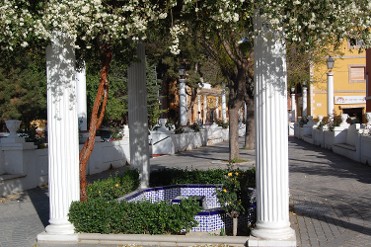
Antiguo malecón de la rambla de la Cruz, hoy rambla D. Diego. En la década de los 50 se transformó en jardín, dándole un aspecto clasicista al adornarlo con columnas simulando capiteles romanos. Desde allí se puede disfrutar de unas maravillosas vistas al castillo.El jardín ha sido remodelado posteriormente, y en el año 2009 se recuperó el aspecto original de su fuente al instalar en ella una reproducción de la figura que la ocupó desde su creación y que constituía una de las más emblemáticas del municipio, se trata de un niño desnudo sentado sobre sus rodillas y portando en sus manos dos peces. El 20 de mayo de 2018 se inauguró, en este jardín, el monumento a los alhameños víctimas de los campos de concentración nazis.
CARTAGENA
Puerto de Cartagena
CARTAGENA
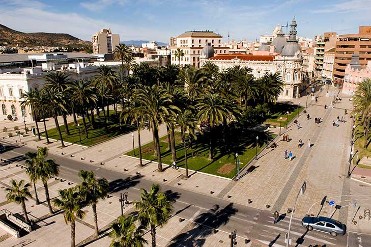
The expansion of the port meant a radical change in the city. In 1904, a building for the Junta de Obras del Puerto (Port Works Board) was constructed on the quay, which led to the drying out of the boat dock, giving rise to what would later become the Plaza de los Héroes de Cavite, next to the Palacio Consistorial. By 1915 the space was created and marked the difference between the leisure and commercial areas of the port. In 1923 its ornamentation was completed with the monument to the Heroes of Cavite and Cuba, the work of the sculptor Julio González Pola, made by public subscription. The tribute to the fallen in the Disaster of '98 was placed in Cartagena because it was the port of departure of the Cuban squadron and the place of origin of a large part of the contingents of troops. In 1926 and 1930 the buildings of the Board of Works of the Port and Customs that surround the square were completed. Over the years, the design of its landscaping has varied, but two botanical elements have always remained: the palm trees and the rosebushes. The gardens also contain a protected endemism, the fan palm, considered to be the only palm tree in Europe. . It is distributed along the Spanish Mediterranean coast, growing naturally in the mountains and hills of Cartagena. Since the 1990s, the square and its surroundings have been remodelled as a pedestrian area.
ÁGUILAS

Pza. de España
30880 - ÁGUILAS
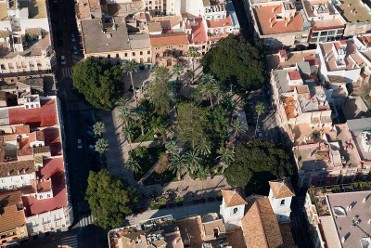
Bello jardín con gran variedad de árboles y de plantas de distintas especies, destacando entre ellas sus Ficus centenarios procedentes de Brasil. Construida en 1874, en su centro está situada una fuente, con una escultura conocida popularmente como " La Pava de la Balsa". A esta plaza confluyen ocho calles de las principales de la ciudad. A su alrededor existen varias fachadas de gran belleza del s. XIX. En el lado Oeste destaca la fachada Neomudéjar del Ayuntamiento.
MOLINA DE SEGURA
Parque de la Compañía
30500 - MOLINA DE SEGURA
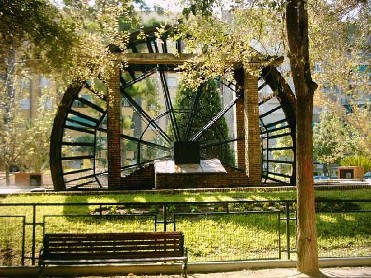
El Parque de la Compañía es por su gran dimensión un referente en el municipio. Cuenta con una superficie total de 70.000 mts² y alberga 750 tipos de plantas. Este gran espacio verde está situado en los terrenos donde se emplazó hace siglos la residencia de la Companía de Jesús que ya en 1590 tenía posesiones en Molina. Cuenta con una noria del S.XVIII, instalada por los jesuítas y que regaba los huertos de su propiedad. La noria original estaba situada sobre la acequia Subirana. El emplazamiento actual, en pleno Parque de la Compañía, no es el original aunque sí cercano. Fue restaurada en 1993 por la Escuela Taller Municipal. En el Parque de la Compañía podemos disfrutar de diferentes zonas, distribuidas en las siguientes áreas: Juegos infantiles. Juegos biosaludables. Pipicán para las mascotas. Auditorio Municipal. Zonas ajardinadas. Mantenimiento. Centro Comercial Vega Plaza.
TORRE PACHECO
Plaza Don Amalio Fernández Delgado
30700 - TORRE PACHECO
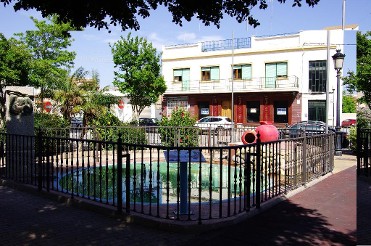
It was inaugurated on October 6th, 1967 and is dedicated to Doctor Amalio Fernández Delgado, although it is better known as "Parque de los Patos". Don Amalio, known as "the children's doctor", spent his summers in Torre Pacheco in La Finca de la Peña, situated at the crossroads of Los Meroños school. He was a very kind person due to his proximity to the school and he used to cure sick children from families without resources without asking for financial compensation. The square is decorated with a stone and bronze monument of great human expression where the hands of Don Amalio appear caressing the heads of three children. In the past, this place was home to a food market and there were ducks (patos) in the fountain, hence its name. Today it is a modern playground with the fountain preserved.
RELLANO (MOLINA DE SEGURA)
El Rellano
30627 - RELLANO (MOLINA DE SEGURA)
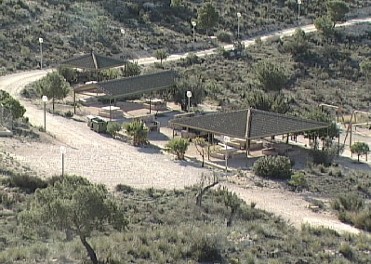
El Parque Ecológico Vicente Blanes fue creado en 1999 el municipio de Molina de Segura, al sur de la Loma de Planes, en la pedanía del Rellano. Sus 37 Has han sido en su mayor parte reforestadas con pinos carrascos, acebuches, algarrobos, lentiscos, coscojas, almeces, palmitos y pinos piñoneros. Este espacio natural dispone de varios equipamientos que posibilitan su uso y disfrute público, como son: área recreativa, estanque, arboretum, zona de acampada y sendas habilitadas para el conocimiento del espacio. Desde el mirador del Parque Ecológico Vicente Blanes se contempla una espléndida panorámica del Parque Regional de la Sierra de la Pila, lugar de gran riqueza florística y faunística. Una de las maneras más interesantes de conocer el parque y aprender en materia medioambiental, es visitar el Aula de Naturaleza, situada en la pedanía del Rellano. En este espacio, la Concejalía de Medio Ambiente realizó una primera reforestación de especies vegetales autóctonas. Entre los servicios con los que cuenta este espacio, destacar: -Área recreativa: bancos, mesas, barbacoas, etc. -Zona de juegos infantiles. -Arboretum. -Observatorio de aves. -Zona de acampada. -Miradores: La Loma y Lúgar. -Sendas o circuitos para el conocimiento del parque. -Albergue municipal (Ofrece alojamiento para facilitar el conocimiento natural del parque y sus alrededores, además es un recurso para el fomento del turismo rural). -Piscina.
MORATALLA
Plaza de la Glorieta
MORATALLA
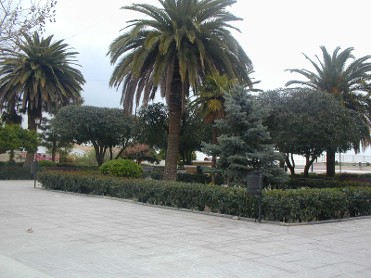
LA GLORIETA La Glorieta, Is a Garden located in the centre village and it is one of the oldest gardens the town, where various leisure and cultural activities take place. One of the most significant buildings in Moratalla, the Trieta Theatre, was built on it in 1917.
TORRE PACHECO
Plaza del Ayuntamiento, 1
30700 - TORRE PACHECO
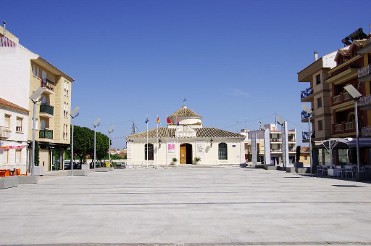
In 1867 this square was built on the confiscated Era de los Frailes Trinitarios and in front of the then recently built Council House, to be gradually developed as a roundabout and continue to take on various names throughout history, although in spite of everything it has always been known as the Town Hall Square. This square has witnessed and played a leading role in the most important events along with the other two emblematic squares that are adjacent to it. It is also a focal point for welcoming visitors, neighbourhood meetings, festive celebrations, children's games, work-life balance and citizen participation, in short, the heart of the town of Torre Pacheco. In 1930 there were large pine trees and stone benches in El Cabezo Gordo. In 1933 it was renovated. Later, in 1956, the drinking water from the Taibilla river arrived and a fountain was installed: first a large ornamental one, then another simpler bowl-type one and then it disappeared. Today it is an open square joined to the adjacent squares and the main street where shops, banks and cafes can be found. In this square is located the Old Town Hall where the Torre Pacheco Tourist Office is located. On 21st December 2017, a time capsule was installed on the steps leading up to the Old Town Hall, which will be opened after 50 years to coincide with the 200th anniversary of the Plaza del Ayuntamiento, specifically on 21st December 2067. Coins, newspapers, letters and photographs from different groups, schools, public personnel and other residents of Torre Pacheco were placed in this capsule.
YECLA
Parque de la Constitución
30510 - YECLA
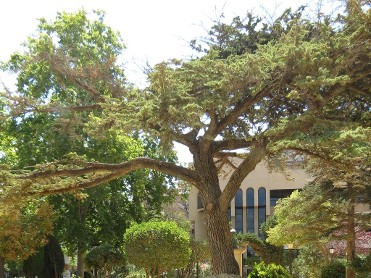
The Parque de la Constitución was until a few years ago the only and most important public garden in Yecla (Murcia). It was not just another garden, it was "the garden" or the "Roundabout", the latter being the name by which it was known for decades. It is still the most interesting garden in the city due to its age, the number of building and investments that have been made since its inception, some of which have been conserved and others that have not, and especially because of the enormous importance that it had for the town as a place for walking and recreation for more than a century. It is also worth mentioning the great diversity of plant species that populate it, with some trees dating back more than a hundred years.
CARTAGENA
Plaza de San Francisco
CARTAGENA
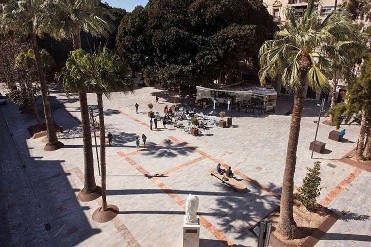
The square is located in the space formerly occupied by the Convent of San Francisco, after whose disentailment the square was built in 1844. The original design of the square was by the municipal architect Carlos Mancha, but it underwent subsequent changes made by the architect Tomás Rico, both in its botany and in other technical aspects. In 1927 the square was adorned with a statue of an illustrious Cartagena native, the actor Isidoro Maiquez. His quality and innovation in acting, and his contribution to the Spanish stage with his "Reglamento de teatros" which completely modernised the Spanish theatre scene, earned him recognition in his time from important figures, such as his great friend Francisco de Goya, who painted his portrait in 1807, which is now on display in the Prado Museum. Photographs of the inauguration of the monument to Maiquez are preserved, in which it is curious to note that the most outstanding botanical elements of the square, its large ficus trees, did not yet exist. Other old images from the beginning of the century show the existence of pine trees, of which only one remains today, located on the corner of the square towards Campos street, which despite its greater height, goes unnoticed among the branches of the large ficus that encloses it. Of the modernist architecture surrounding the square, the Casa Maestre stands out. The house was designed by the architect Marceliano Coquillant and is inspired by Gaudí's Casa Calvet. The central axis of the building starts from the door decorated with rococo details, passing through the large, typically modernist bay window. On the façade, the undulating decoration with plant motifs stands out, integrating all the work of the decorative arts in wrought iron, wood and glass. The latest remodelling of the square has greatly changed its appearance, also integrating with the layout of its paving the remains of the Roman forum that lie beneath it, thus making present the entire historical period of occupation of this space as a public place, a fact commemorated by a sculpture of Augustus located in one of its corners and which is a replica of the original found in the Curia of the Roman forum.
TORRE PACHECO
Plaza de la Iglesia
30700 - TORRE PACHECO
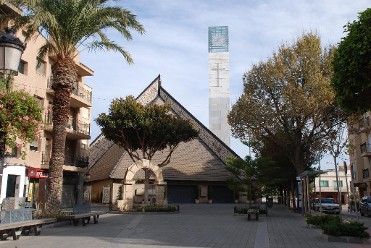
In the garden of the square there is a stone ewer that belonged to the sacristy, as well as the entrance arch to the previous church (a Cultural Property), previously located in the Dean's palace and belonging to the 16th century. The primitive hermitage was attached to the palace, obtaining the rank of parish in 1603. In 1704 the Dean's house was demolished but the arch was kept as a new access to the temple and its two columns were also preserved. Next to all this we find an iron cross decorated with flowers and linked to "Las Cruces de Mayo". The history of Torre Pacheco is linked to its parish. The current church has a white marble foundation stone on its facade, rescued from the primitive parish church founded by Dean Mr. Luis de Pacheco, which is quoted in the following text: "This church was blessed and declared a parish church being Pope Clement VIII, King of Spain, Don Felipe the Third, Bishop of Cartagena Don Alonso Coloma, Dean Don Luis Pacheco de Arroniz, Chaplain to His Majesty and Lord of this Country Estate. Year 1603". Next to this tombstone there is a second one that refers to the construction of the primitive tower of the church in 1704. It is made of stone from el Cabezo Gordo and contains the following text: "This tower was built and extended at the expense of the devout parishioners, with Don Agustin II Del Baño as the parish priest. The year 1704". Likewise, the heraldic emblem of Dean Don Luis de Pacheco is oval in shape, as befits an ecclesiastical dignity, and contains four quarters corresponding to the Pacheco - Arróniz - Pérez de Barrada and Grimaldo families. In the quarter dedicated to the Pacheco family, the boilers can be seen with the serpents that the emblem of Torre Pacheco has conserved.
CARTAGENA
Calle San Diego
30201 - CARTAGENA
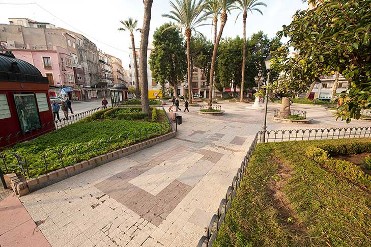
In the 17th century, the City Council decided to create a new square named after the convent of La Merced - now disappeared - which overlooked it. As it was the most spacious square in the city, it was the venue for the events with the largest crowds, such as the now defunct August Fair, and since 1761 it has been the venue for the Easter Encounter, one of the most important moments of this celebration, which has been declared of International Tourist Interest. In 1878 it was completely remodelled, with a design by D. Eugenio de la Garaganza, Chief Engineer of the Plantations and Gardens of Madrid, in accordance with the needs of the climate, specifying the type of irrigation and recommending tropical plants as botanical species, such as the araucarias or Norfolk pine and the ombú trees with their impressive roots that still adorn it today. After several remodelling works, in 1926 the sculpture in homage to Commander Villamartín, a military man from Cartagena who has gone down in history for being the author of several works that, within military-historical thought, place him at the level of the great international figures, and is still the subject of study in military academies. Since 1901, the square has been embellished by the modernist architecture of the Palacio Aguirre, built by Víctor Beltrí as the family home of the wealthy miner. The building is notable for the axis from which the two façades unfold, with a corner tower and a belvedere on the first floor. The tower's glazed ceramic scales roof and the ceramic decoration on the upper part of the façade, with plant and child motifs in a rococo style, give it a decorative and colourful liveliness. In its last remodelling, the Palacio Aguirre was internally connected to the adjoining building, and is currently home to the Regional Museum of Modern Art - MURAM. The history of this space is enriched by the recent archaeological finds that remain visible until their future enhancement. Its explanatory panels provide information on how in ancient times the Decumanus Maximus, the road leading into the city in the Augustan period, ran through here, a possible monumental nymphaeum and, beneath it, the remains of a Punic house, about which the first archaeological hypotheses show the signs of the time of the Roman conquest of the city by Scipio's troops. From the square starts a new green space, the result of the recent urban reforms of the surroundings, which serves as access and transition between the lower area of the Plaza de la Merced and the higher area of the new University Campus. The Boulevard José Hierro is thus born, in honour of the great poet and winner of the Cervantes Prize who spent long periods of his life in our city. This boulevard has a contemporary concept, where, in addition to relaxation and rest, other types of activities can be carried out. It is home to local plant species or those that are already adapted to local conditions, as they require less maintenance and at the same time have a higher social value.
SAN JAVIER
PARQUE ALMANSA
30730 - SAN JAVIER
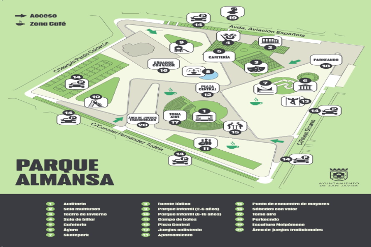
It is the largest park in the municipality of San Javier. It houses the new Winter Theater with a capacity of 500 people. Inside, the Municipal Auditorium Parque Almansa stands out, representing the most important cultural forum in San Javier. It is an open-air auditorium designed in the shape of a semi-circle, reminiscent of classical theaters, with architecture that enhances acoustics and visibility from any point within the structure. The Auditorium hosts numerous cultural events annually, among which the International Theater and Dance Festival and the International Jazz Festival stand out.
CARTAGENA
Parque Cornisa
CARTAGENA
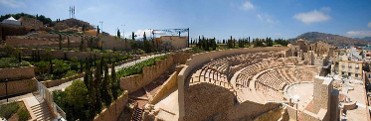
Inaugurated in 2008 together with the museum and archaeological complex of the Roman Theatre, it creates a landscape unit with the Theatre and Torres Park. The most remarkable is the archaeological remains of a small worship altar, a section of the Republican Roman wall or a reservoir that supplied water to the monumental building.
SAN JAVIER
Calle Maestre con Calle Jabalina
30730 - SAN JAVIER
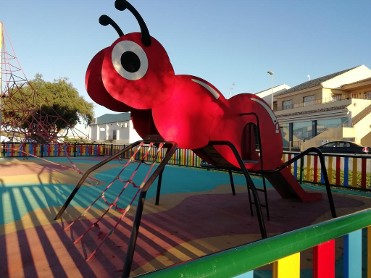
Central park, close to the Municipal sports Center, with a children's play area, a dog park, and a zip line. Popularly known as the Ant Park.

SANTIAGO DE LA RIBERA (SAN JAVIER)
Calle San Alfredo
30720 - SANTIAGO DE LA RIBERA (SAN JAVIER)
Park located in the San Blas neighborhood, near its chapel, with bio-healthy exercise equipment and a children's play ara.
CIEZA
Callejón del Cantón, s/n
30530 - CIEZA
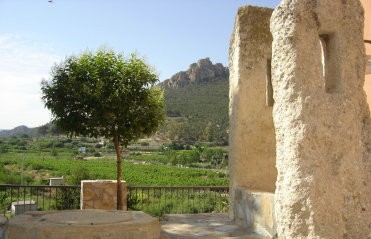
La Almazara de Casa Grande se encuentra situada sobre el solar que anteriormente ocupaba una casa de varias plantas, ocupando dicha construcción su sótano. Se concervan tres ejes de prensado, dos molinos troncocónicos, varios fragmentos de otros, un ara para el prensado de los confines, varios fragmentos de la solera y otros elementos tallados en la roca. Resulta interesante resaltar que junto a la almazara se han hallado una serie de perforaciones en la roca, una de las cuales es una mina de agua de la que manan unos 100 litros diarios. La presencia de agua en la almazara era algo imprescindible para el lavado de la oliva y otros procesos posteriores. La almazara se articulaba en dos terrazas, las cuales quedaban por debajo del nivel del suelo. Se trata de un claro y buen ejemlo de conservación del patrimonio ya que la almazara ha sido musealizada y conservada dentro del recinto de un jardín, para ello se ha respetado el aterrazamiento original de la almazara. Se pueden observar en él las principales piezas del proceso de fabricación del aceite. La oliva se echaba a la tolva y de ahí pasaba a la muela donde se trituraba la oliva y se hacía una pasta que se ponía en cestos y se prensaba, allí se separaba la parte líquida de la sólida. Posteriormente se sometía el líquido resultante a un proceso de decantación para poder depurarlo y guardarlo en contenedores.
LA ESTACADA (JUMILLA)
pedanía de la estacada
30520 - LA ESTACADA (JUMILLA)
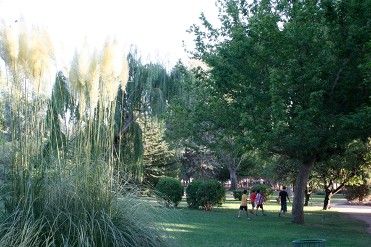
It was created by the I.R.Y.D.A. of particular interest are its conifers and bird-life. It features more tan 150 species of ornamental tres, shrubs and perennials, as well as number of typical native plant species, both from the Jumilla district and from the Iberian península.
MURCIA
C/ Alcalde Gaspar de la Peña
30004 - MURCIA
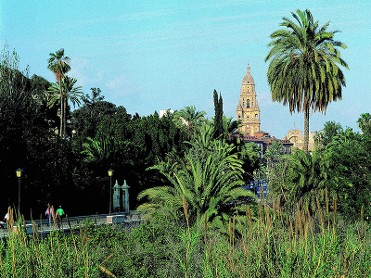
En el margen derecho del río Segura se ubica el Paseo del Malecón, que se caracteriza por adentrarse en la huerta murciana. Tiene su origen en el siglo XV cuando sirvió de muro de contención a las crecidas del antiguo Thader. El paseo se reedificó en 1736 y actualmente muestra interesantes edificaciones como casas de principios del siglo XX o el Monasterio de la Beata Ángela Astorch.
OJÓS
30611 - OJÓS
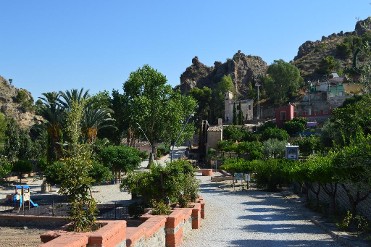
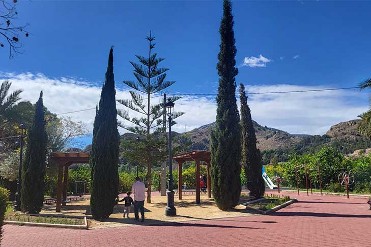
Se inauguró en octubre de 2013, con motivo de la Conmemoración del IV Centenario de la Expulsión de los Moriscos en el Valle de Ricote. Simboliza la convivencia de las tres culturas que más han influido en la cultura de España, como son la cristiana, la mulsulmana y la judía. Están representadas por tres árboles: la palmera representa la cultura musulmana, el olivo la judía y el ciprés la cristiana (significa la resurrección). El cedro del Líbano también está incluido en la zona central porque es una madera muy resistente que representa la fortaleza de la unidad entre dichas culturas.
OJÓS
30611 - OJÓS
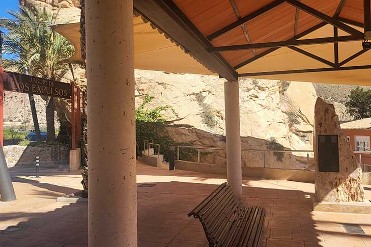
En este jardín destaca un monolito (estalagmita procedente de una cantera de mármol de Pinoso) donde están inscritos los nombres de los vecinos de Ojós que se vieron afectados por el bando de expulsión del rey Felipe III del año 1613 que ordenaba la expulsión de los denominados moriscos, que eran los descendientes de los musulmanes cristianizados en el año 1501. El Valle de Ricote es considerado el último reducto morisco de la Península. Este jardín está situado en los terrenos que ocupaba el antiguo cementerio de Ojós, por lo que es una forma de recordar a estos vecinos. Existen datos que avalan la permanencia de la mayoría de ellos a pesar de la orden de expulsión, como se demuestra en la pervivencia de apellidos de familias que fueron expulsadas. La expulsión, además de injusta, agudizó la crisis económica, con escasez de mano de obra, subida de impuestos y las consecuencias de las riadas y la Peste de 1649. Para recordar estos hechos el Ayuntamiento de Ojós ha institucionalizado la Conmemoración de los Expulsos, que se celebra el tercer fin de semana de octubre de cada año, desarrollando una serie de actos que tienen como referencia la historia de nuestros antepasados a través de sus costumbres, indumentaria, música, gastronomía, etc., destacando la representación teatralizada de este hecho histórico a través del grupo de teatro Asociación Cultural San Bartolomé de Cieza, en la que también participan vecinos del municipio. Además encontramos en el Jardín de los Expulsos un auditorio al aire libre, donde se realizan muchas de estas actividades.
OJÓS
30611 - OJÓS
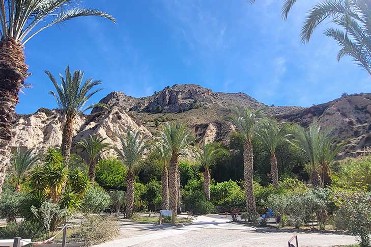
Cuenta con unas vistas privilegiadas junto al rio así como con zonas ajardinadas, de recreo, para picnic y con juegos infantiles, ideal para familias
OJÓS
30611 - OJÓS
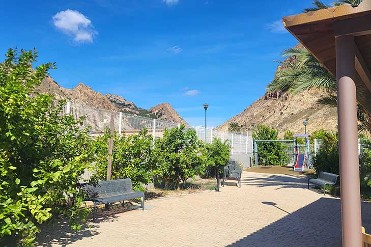
Inspirado en el jardín huerto de la mitología griega. Las Hespérides eran ninfas que se transformaron en árboles cuyos nombres hacen referencia a los matices del cielo cuando el sol va hacia el ocaso y que custodiaban un jardín que estaba lleno de diferentes tipos de árboles frutales, entre los cuales se encontraba uno consagrado a la diosa Hera. El jardín de las Hespérides de Ojós se ubica junto a la piscina municipal, formando parte de sus instalaciones, contando con dos pérgolas y equipamiento infantil, y donde podemos encontrar más de veinte variedades de cítricos como cidro, limoncillero, kumquat, mano de Buda, pomelo, mandarino, naranjo, etc.