

Festivities
Santa Cruz (Murcia)
A alabar a la Madre de Dios. A eso se dedicaban los conocidos como "Auroros" entre los siglos XVIII y XIX. Se trata de miembros de hermandades o cuadrillas que se dedicaban a cantar o a alabar a la Madre de Dios entre la noche y el día. Los Auroros son los continuadores de una tradición religiosa-folclórica que consistía en salir en procesión de noche o con las primeras luces del día haciendo replicar campanas y entonando cánticos religiosos. A esta tradición Díaz Cassou la denominó "el alma de Murcia".




Coches de alquiler
Cartagena
Conductor: No. Vehículos: Turismo. Características: Previa reserva se puede recoger y dejar en el Aeropuerto de San Javier.


Monuments
Lorca
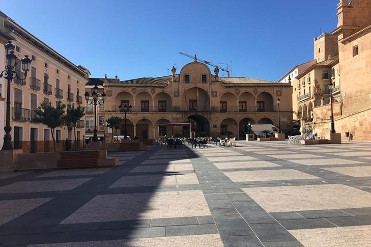
The south wing of the current building, which used to be a city prison, was turned into the new rooms of the council when the building size was doubled. Consequently it gained an overall aesthetic appearance more appropriate to the social sector that had became the most noble and illustrious sector in the city. The extension of the building was based on the plans of Alfonso Ortiz de la Jara (a master mason from Caravaca), who respected the former order and style and combined both sides so harmoniously that it seems to be built in one go. The building consists of a double and open loggia standing on smart Macael (a municipality of Almería) marble columns. Its style is Renaissance, which contrasts with the rich and ornate Baroque of that time. Next to the pediment which crowns the central arch with an iron and projecting balcony there are two sculptures from Juan de Uzeta symbolizing Justice (Justicia) and Charity (Caridad). The Sala de Cabildos, the former plenary hall has been opened to visits. The secret chapel, which was added to this former hall in 1768, is still preserved. The most remarkable element can be worshipped, which is is the image of the Purísima (one of the numerous Spanish names for the Virgin). Its acquisition and authorship are not precisely known. In this regard, there is a unique fieldwork by Professor Mrs García Gainza, who points out the influence of that sculpted by Alonso Cano in 1655 for the Cathedral of Granada. According to her, it is related to Pedro de Mena's workshop around 1670. As far as the paintings in the hall are concerned, a small collection of iconography relating to the military history of the city is exhibited. If booked, Sala de Cabildos can be visited, which nowadays is used for different activities such as weddings receptions, talks, lectures, courses, press conferences, but especially for entertaining and visits.
Monuments
Yecla
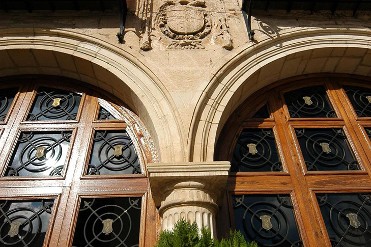
Destaca su fachada labrada en piedra de sillería, formando un pórtico de doble arco adjunto, apoyado en columnas de orden toscano. Encima de estos portones se encuentran sendos balcones gigantes protegidos por antepecho de forja. Además se distingue entre los balcones el blasón o escudo imperial, en relieve, de Carlos V con el Águila bicéfala. Arriba del blasón, se encuentra el escudo de Yecla, en el cual se puede leer el calificativo de «Muy Noble, Muy Leal y Fidelísima villa de Yecla» desde 1707.
Monuments
Abanilla
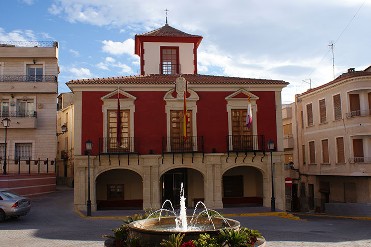
The Town Hall is a civil building of the 18th century, which was built between 1751 and 1762 during the reign of Ferdinand VI of Spain. This building preserves the windows, iron fittings and mouldings from that period. It worked as a royal prison and granary, whose access door has been recently discovered in the south after a renovation of the facade. Its interior is functional and mainly for administrative use. Its facade and surroundings are also relevant.


